

Your chairs are empty. Somewhere in your city right now, five people are searching for a dentist. None of them found you.
If that sounds familiar, you’re not alone. Most dental practices struggle with one problem: they don’t know how to fill their patient book consistently. They try one thing, it doesn’t work fast enough, and then they stop. What they don’t realize is that patient acquisition isn’t about luck or one perfect tactic. It’s about building a system.
This guide walks you through the exact channels that work for dental practices, why they work, and how to set them up so new patients keep showing up without you doing the same sales work over and over.
Understanding Your Patient Acquisition Funnel
Before we talk channels, let’s talk about the funnel. Most dental practice owners think patient acquisition is binary: either someone calls or they don’t. But there are actually five stages between a stranger and a booked appointment.
Stage 1: Awareness. Someone realizes they need a dentist. They might have a toothache, need a cleaning, or just moved to your area. They turn to Google, ask a friend, or scroll social media.
Stage 2: Consideration. They find your practice online. They land on your website or Google Business Profile. They look at your photos, read your reviews, check your hours. They’re evaluating whether you’re trustworthy.
Stage 3: Decision. They decide to book. They either click a booking button, pick up the phone, or send you a message.
Stage 4: Booking. The appointment is actually in the calendar.
Stage 5: Retention. They show up, have a good experience, and come back for their next cleaning or treatment.
Most practices only focus on Stage 1. They run ads, hope someone sees them, and then wonder why nobody calls. They ignore the fact that half the people who find them never book because the booking process is confusing, your reviews are mediocre, or your website looks like it hasn’t been updated since 2015.
Patient acquisition that works requires you to think about all five stages at once.
The 4 Core Channels for Dental Patient Acquisition
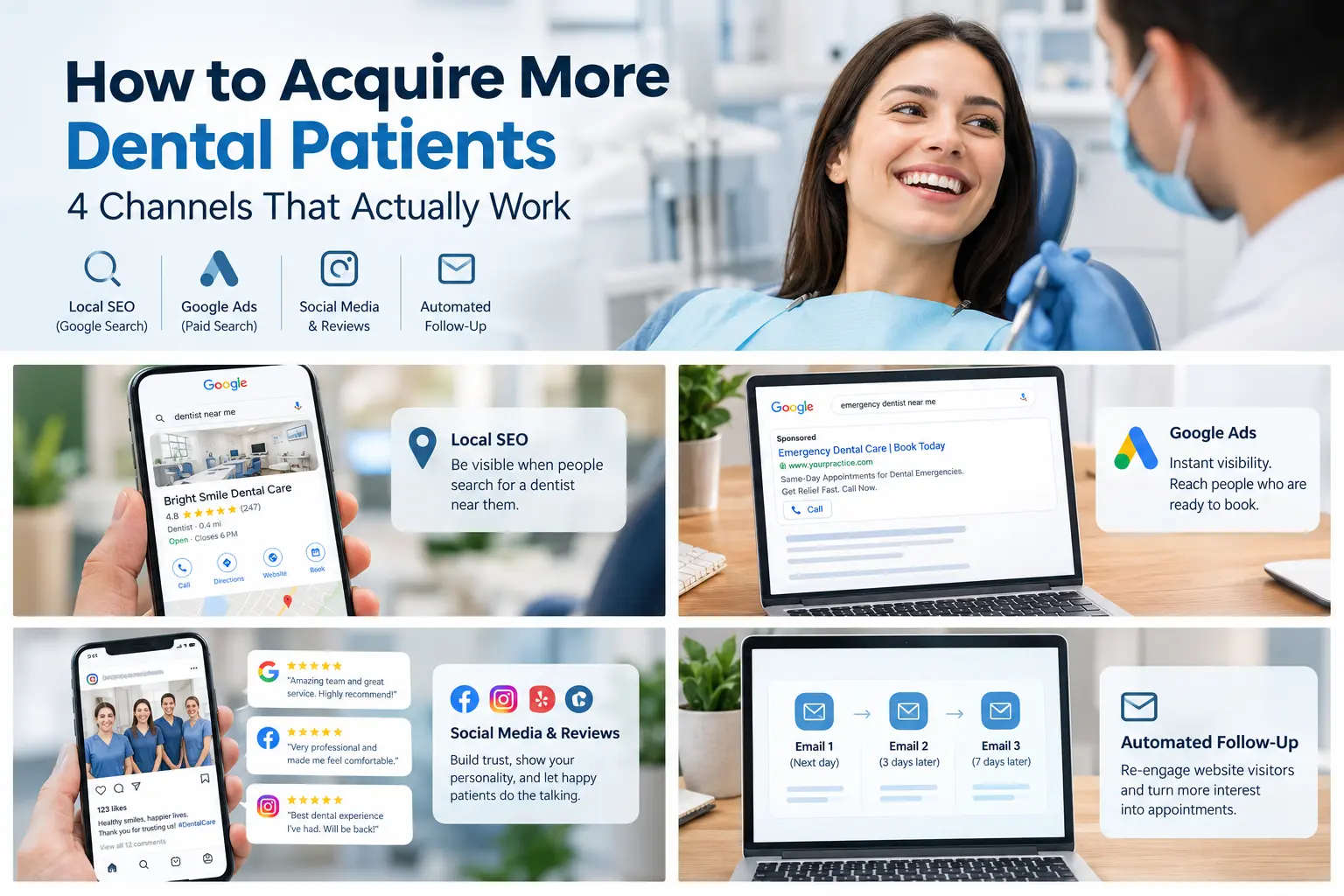
Here are the four channels that consistently bring new patients to dental practices. Each one works differently, reaches people at different points in the funnel, and requires different effort to set up.
Channel 1: Local SEO (Google Search)
This is the workhorse channel. When someone needs a dentist, their first instinct is to search “dentist near me” or “dentist in [your suburb].” Local search happens on Google Maps and the Google Search results page, and if your practice shows up there with a good profile, photos, and reviews, people will call.
Why it works for dentists: Local search intent is high. People are ready to book. They’re not researching for fun. They have a problem and they want to solve it now.
How to set it up: You need three things working together:
- A complete, accurate Google Business Profile. Your name, address, phone number, and hours have to be exactly right. Your photos should be clear and professional. You should have a appointment booking button right there on your profile.
- Patient reviews on Google. Reviews are the single most important factor in local search ranking and in whether someone actually calls. The more recent reviews you have, the higher you rank. Dental practices that actively ask patients to leave reviews consistently rank higher and get more calls.
- Your website optimized for local search. Your location pages should mention your suburb, your service areas, and the treatments you offer. The language on your site should match the language people use when they search.
Realistic timeline: 30-60 days to see meaningful movement in your rankings, assuming you don’t start from zero.
One tactic: Ask five patients a week to leave a Google review. Not in a pushy way. Just hand them a card with a link, or send a text after their appointment with a link to your review page. Over a year, that’s 250 new reviews. That changes everything.
Channel 2: Google Ads (Paid Search)
Local SEO takes time. Google Ads is instant. The moment someone searches for a dentist in your area, your ad appears. They click it, land on your website, and either call or book an appointment.
Why it works for dentists: You’re only paying when someone clicks your ad. You’re only showing your ad to people actively searching for a dentist. The intent is as high as it gets.
How to set it up: You need a Google Ads account set up to run search ads in your local area. Your ads need to be written to match what people are searching for. Your landing page needs to be clear about what treatment you offer and how to book. And you need to track whether people who click your ad actually become patients, so you know what you’re paying per new patient.
Realistic timeline: You can get ads live in a day. It takes 7-14 days to have enough data to see if they’re working. After 30 days, you should know whether the ads are worth the spend.
One tactic: Create one ad specifically for emergency dental searches. When someone searches “emergency dentist near me,” your ad shows up, they click, and they book an emergency appointment. This alone can add two to three patients a week if you handle emergencies.
Channel 3: Social Media and Reviews
People trust people. They trust reviews even more. A new patient scrolling their Facebook feed might see your ad, but they’re not going to book until they’ve checked your reviews, looked at your before-and-after photos, and felt like they know you a little bit.
Why it works for dentists: Dental decisions are emotional. People are nervous about dentists. They want to see that other patients had a good experience. They want to see that you’re real, you’re friendly, and you know what you’re doing.
How to set it up: Post regularly on Facebook and Instagram. Show your team, talk about treatments you do (like teeth whitening results or Invisalign transformations), and ask patients to share their stories. Respond to comments. Reply to reviews. Make it clear that you’re a real person running this practice, not a corporate machine.
Also get your practice on Yelp and TreatWell if you’re not already. Ask patients for reviews everywhere. Respond to negative reviews professionally (one bad review answered well can actually build trust).
Realistic timeline: You’ll start seeing engagement within a week. New patient calls from social might take 60-90 days because it’s a slower, relationship-building channel.
One tactic: Once a month, ask a patient if they’d be willing to film a 30-second video about their experience. “I was nervous about Invisalign, but Jarvis made it so easy.” That one video will generate more calls than months of your own posts.
Channel 4: Automated Follow-Up
Half of your potential patients don’t book the first time they visit your website. They land on your page, they’re interested, and then they close the tab and forget about you. A month later, they have the same problem, they search again, and they book with a competitor instead.
Automated follow-up captures those people. When someone visits your website or clicks your ad but doesn’t book, they get an email or SMS the next day with a reason to book. No extra effort from you. Just a system running in the background.
Why it works for dentists: Most practices do zero follow-up. They assume that if someone doesn’t book on the first visit, they’re not interested. But people are busy and forgetful. A gentle reminder (“We have appointments available this week”) is often enough to get them to book.
How to set it up: You need software that can track website visitors and send them automated messages. GoHighLevel does this. So does Acuity or Zoho. The setup takes a few hours, then it runs on its own.
You also need landing pages that collect email addresses. An offer helps: “Book your cleaning this month and get 20% off your first whitening.” People give you their email because there’s something in it for them.
Realistic timeline: 14-30 days to have the system live and working. After that, it generates leads passively.
One tactic: Create a simple email sequence. Email 1 (next day): “Hi, saw you checked out our booking page. Any questions?” Email 2 (3 days later): “Still thinking about it? This month we have evening appointments.” Email 3 (7 days later): “Last chance for May availability.” That’s it. Three emails. Some of those leads will convert.
Why Most Practices Fail at Patient Acquisition
Here’s the hard truth. Most dental practices don’t fail because patient acquisition is impossible. They fail because they do one thing, halfway, for two weeks, and then give up.
They run Google Ads but don’t optimize them. They post on social media twice and then stop. They implement local SEO but don’t ask patients for reviews. They get discouraged that results aren’t instant and conclude that “none of this works.”
Patient acquisition isn’t magic. It’s systems. It’s doing multiple things at once, each one supporting the others. Local SEO builds trust. Reviews build trust. Social posts build trust. Ads reach people. Follow-up captures people who weren’t ready. All four channels working together create a flow of new patients that doesn’t stop.
The practices that are consistently full are the ones that have this system in place. And most of them don’t build it themselves. They hire someone who knows how to set all four channels up at once, monitor them, and keep them working.
That’s the difference between a practice with quiet weeks and a practice with a full schedule.
Your 30/60/90 Day Action Plan
You don’t need to build everything at once. Here’s how to get started.
Month 1: Audit and Prepare
Spend this month getting your foundation right. You can’t run ads to a bad website. You can’t get reviews if patients don’t know where to leave them.
Do this:
- Audit your Google Business Profile. Is all your information correct? Do you have photos? Do you have a booking button?
- Check your website. Does it have a clear call to action? Can someone book an appointment in three clicks or fewer?
- Look at your reviews. How many do you have? What are they saying?
- Set up review request systems. Choose one review site and commit to asking patients for reviews.
This month is unglamorous. But it’s the difference between ads that work and ads that fall into a leaky bucket.
Month 2: Optimize Existing Channels
Now you have your foundation. You can start driving traffic.
Do this:
- Launch local SEO work. Make sure your location pages are optimized. Start asking for reviews.
- Launch Google Ads. Start with a small budget ($500-1000 a month). Run ads for “dentist near me,” emergency dentist searches, and specific treatments you want to fill (like teeth whitening).
- Post on social media. Two posts a week minimum. Mix your own content with patient testimonials.
By the end of Month 2, you should have new patients coming from Google search and Google Ads. You should have at least a few new reviews.
Month 3: Scale What Works
You now have data. You know which channels are bringing patients and at what cost. This month, you scale.
Do this:
- Keep asking for reviews. By now you should have a steady flow.
- Increase your Google Ads budget by 25-50% on the ads that are actually converting.
- Set up automated follow-up on your website. This is the month to implement email or SMS automation.
- Expand social media. If videos worked, make more videos. If before-and-afters worked, post more before-and-afters.
By the end of Month 3, you should have a working system. New patients should be coming in regularly from multiple channels. You should know what your cost per patient is. And you should have a clear picture of which channels are worth scaling further.
The Real Cost of an Empty Chair
Every empty chair costs you money. A patient visit is typically $200 to $500 depending on treatment. A full year of one patient seeing you twice a year is $400 to $1000 in revenue. Over three years, that’s $1200 to $3000 per patient. Over five years, it’s $2000 to $5000.
When you don’t have a patient acquisition system, you’re not just losing one patient. You’re losing dozens of them every year. You’re losing thousands of dollars.
The opposite is also true. A practice that fills its schedule through a working acquisition system doesn’t need to discount. Patients come to you. You get to choose which patients you work with. You raise your prices. You have waiting lists.
The difference between a busy practice and a quiet one isn’t talent or luck. It’s a system.
What’s the Next Step?
Patient acquisition done right is not complicated. It’s four channels working together. But doing it right takes time, attention to detail, and the ability to manage multiple campaigns at once.
If you want to stop guessing and build a working patient acquisition system, we can help. Our digital marketing for dentists service handles all four channels: local SEO, paid search, social media, and automated follow-up. We set it up, we monitor it, and we optimize it so you don’t have to.
The first step is simple. Let’s have a conversation about your practice, how many patients you want to add, and what’s stopping you from getting there now.
Book a free strategy call with our team. We’ll audit your current patient acquisition setup, identify the fastest wins, and show you exactly what a working system looks like for your practice.